English
 Español
 русский
Sourcing a full range of bearings from a single supplier — or understanding the complete bearing spectrum for a procurement or engineering decision — means working across more than a dozen distinct bearing families, each optimized for different load types, speeds, temperatures, and mounting constraints. No single bearing type covers all applications, and selecting the wrong type routinely causes premature failure, increased maintenance costs, and unplanned downtime.
This guide maps the full bearing range — from deep groove ball bearings to plain bearings and everything in between — with practical guidance on load capacity, speed limits, and the specific conditions each type handles best.
What "Full Range" Actually Covers
Major bearing manufacturers such as SKF, NSK, FAG (Schaeffler), and Timken each list between 40,000 and 100,000 individual bearing part numbers in their catalogues. That breadth reflects variations in bore diameter, outer diameter, width, internal clearance, cage material, seal type, and precision grade — not just bearing family.
At the family level, a full range of bearings encompasses:
- Deep groove ball bearings
- Angular contact ball bearings
- Self-aligning ball bearings
- Cylindrical roller bearings
- Tapered roller bearings
- Spherical roller bearings
- Needle roller bearings
- Thrust ball bearings
- Thrust roller bearings
- Slewing ring bearings
- Linear bearings and bushings
- Plain bearings (bushings, rod ends, spherical plain bearings)
- Specialty and thin-section bearings
The sections below examine each family in depth, covering load direction, typical dynamic load ratings, speed limits, and representative use cases.
Ball Bearing Families: Versatility at High Speed
Ball bearings use spherical rolling elements that make point contact with the raceways. This geometry minimizes friction and allows high rotational speeds, but the limited contact area means lower load capacity compared to roller bearings of the same envelope size.
Deep Groove Ball Bearings
The most widely used bearing in the world. Deep groove ball bearings (DGBB) handle radial loads primarily but also accommodate moderate axial loads in both directions. A standard 6206 bearing (30 mm bore) has a dynamic load rating of approximately 19.5 kN and can run at up to 14,000 rpm with grease lubrication. Available sealed (2RS), shielded (ZZ), or open, they serve everything from electric motors and gearboxes to household appliances and automotive accessories.
Angular Contact Ball Bearings
Designed with a contact angle — typically 15°, 25°, or 40° — that allows them to carry combined radial and axial loads simultaneously. Higher contact angles increase axial load capacity but reduce radial capacity and speed limits. Single-row types must be mounted in opposing pairs to handle bidirectional axial loads. Common in machine tool spindles, pumps, and precision gearboxes where axial stiffness is critical.
Self-Aligning Ball Bearings
Feature a sphered outer raceway that allows the inner ring and shaft to tilt up to 2–3° relative to the housing without generating damaging edge loading. Load capacity is lower than DGBB of the same size, so they are specifically used where shaft deflection or housing misalignment is unavoidable, such as in agricultural machinery, conveyor drives, and long shaft systems.
Roller Bearing Families: Higher Load Capacity for Heavy Duty Applications
Roller bearings use cylindrical, tapered, spherical, or needle-shaped rolling elements that make line contact with the raceways. This distributes load over a larger area, giving roller bearings substantially higher radial load ratings than ball bearings in the same space — typically 1.5 to 3 times higher — at the cost of some speed capability.
Cylindrical Roller Bearings
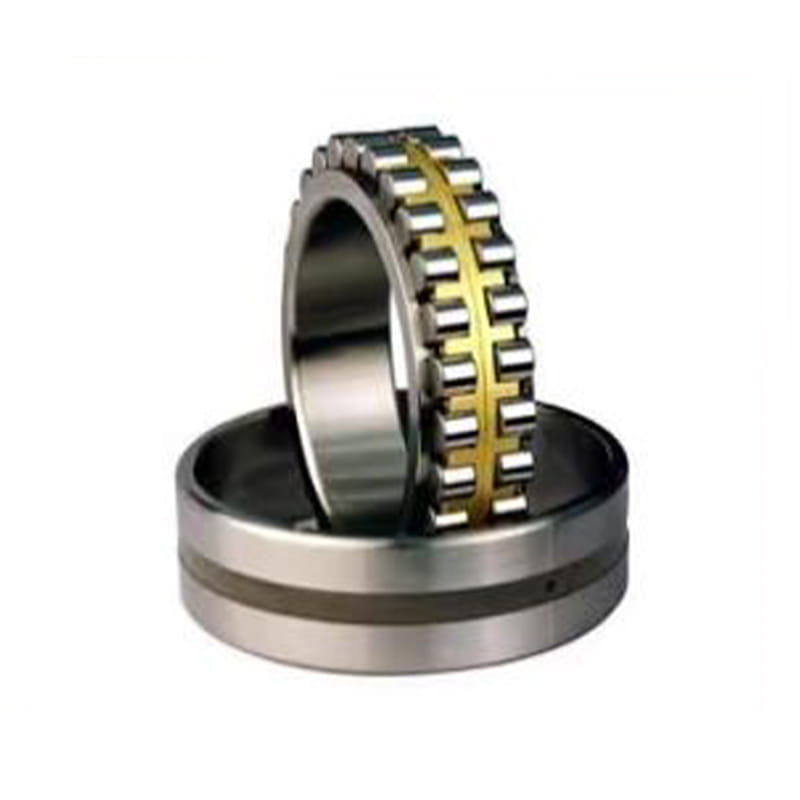
Optimized for pure radial loads with very high rigidity. Most configurations (NU, N series) carry no axial load; NJ and NUP types carry axial in one direction; NF types carry axial in the opposite direction. Widely used in electric motors, rail traction drives, and industrial gearboxes. Speed capability is moderate to high — a medium-sized cylindrical roller bearing typically supports 20–40% higher speeds than a comparable tapered roller bearing.
Tapered Roller Bearings
Carry combined radial and axial loads by virtue of their tapered geometry, where the rolling elements and raceway surfaces converge to a common apex point. This makes them the standard choice for automotive wheel hubs, gearbox shafts, and crane hooks where both load components are significant. Tapered roller bearings must always be mounted in opposing pairs (face-to-face or back-to-back) to manage bidirectional axial loads and preload. A typical automotive front hub bearing set handles dynamic loads exceeding 60 kN.
Spherical Roller Bearings
The workhorses of heavy industry. Spherical roller bearings combine very high radial and moderate axial load capacity with a self-aligning capability of up to 1–2.5°, making them tolerant of shaft deflection and misalignment. Dynamic load ratings for large sizes (e.g., 240 mm bore) exceed 3,000 kN. Found in paper mills, mining equipment, continuous casting machinery, and offshore equipment where loads are heavy and perfect alignment is impractical.
Needle Roller Bearings
Use very thin, long rollers (length-to-diameter ratio of 3:1 to 10:1) to achieve high radial load capacity in an extremely compact radial cross-section. Ideal where bore space is limited but load is substantial — rocker arm pivots in automotive engines, gearbox planet carriers, and two-stroke engine connecting rods. Available as drawn cup types (which use the shaft as the inner race), caged assemblies, or full-complement designs.
Thrust Bearings: Handling Pure Axial Loads
Thrust bearings are designed primarily for axial (thrust) loads acting along the shaft axis. Most types handle little or no radial load and must be combined with radial bearings in most shaft systems.
Thrust Ball Bearings
Available in single-direction (one-way) and double-direction configurations. Single-direction types carry axial load in one direction only and require a separate bearing for the opposite direction. Speed limits are moderate. Common in vertical pump shafts, machine tool tables, and steering columns.
Thrust Roller Bearings (Cylindrical, Tapered, and Spherical)
Handle significantly higher axial loads than thrust ball bearings. Spherical thrust roller bearings also accommodate misalignment and can carry some radial load — making them a practical choice for heavy vertical shaft applications such as crane slewing mechanisms, extruder thrust blocks, and ship propeller shaft assemblies. Dynamic axial load ratings for large spherical thrust roller bearings can reach over 5,000 kN.
Bearing Type Comparison: Load, Speed, and Application at a Glance
The following table summarizes the key performance characteristics across the main bearing families to support initial selection decisions:
| Bearing Type | Radial Load | Axial Load | Speed Capability | Misalignment Tolerance | Typical Applications |
|---|---|---|---|---|---|
| Deep Groove Ball | Medium | Low–Medium (both directions) | Very High | Very Low | Motors, pumps, appliances |
| Angular Contact Ball | Medium | Medium–High (one direction) | High | Very Low | Machine tool spindles, compressors |
| Self-Aligning Ball | Low–Medium | Low | High | Medium (2–3°) | Conveyors, agricultural drives |
| Cylindrical Roller | High | None to Low | High | Very Low | Industrial gearboxes, traction motors |
| Tapered Roller | High | High (one direction per unit) | Medium | Very Low | Wheel hubs, gearboxes, cranes |
| Spherical Roller | Very High | Medium | Medium | High (1–2.5°) | Mining, paper mills, offshore |
| Needle Roller | High | None to Low | Medium–High | Very Low | Engine components, gearbox planets |
| Thrust Ball | None | Medium (axial only) | Medium | Very Low | Vertical pumps, steering columns |
| Spherical Thrust Roller | Low | Very High (axial primary) | Low | Medium | Extruders, crane slewing, propeller shafts |
| Plain Bearing / Bushing | Very High | Varies by type | Low–Medium | High | Construction equipment, low-speed pivots |
Slewing Ring Bearings and Large-Diameter Applications
Slewing rings (also called slew bearings or turntable bearings) are large-diameter bearings — ranging from 200 mm to over 6,000 mm in outer diameter — that support rotating structures carrying simultaneous radial, axial, and moment loads. They are built with internal or external gear teeth in many configurations for driven rotation.
Key applications include crane superstructures, wind turbine pitch and yaw systems, excavator platforms, and radar antenna mounts. A single slewing ring on a 5 MW offshore wind turbine blade pitch system must withstand moment loads exceeding 8,000 kN·m across its service life of 20+ years.
Slewing rings are available in four main configurations:
- Single-row ball type: Most common, suitable for moderate combined loads and smooth rotation requirements.
- Double-row ball type: Higher axial and moment load capacity for medium-duty applications.
- Cross-roller type: Alternating 90° roller arrangement gives exceptional stiffness and accuracy in a compact section.
- Three-row roller type: Separate rows for radial, upper axial, and lower axial loads — highest load capacity of all slewing ring designs, used in the heaviest crane and mining equipment.
Linear Bearings: Supporting Motion Along a Straight Path
Linear bearings support translational motion rather than rotation. They are fundamental components in CNC machine tools, 3D printers, pick-and-place robots, semiconductor handling equipment, and medical devices.
Linear Ball Bearings (LM Series)
Cylindrical housings containing recirculating ball circuits that ride on a hardened shaft. Available in standard, adjustable, and open types. Standard LM series bearings run on shaft diameters from 3 mm to 100 mm. Dynamic load ratings for a 20 mm shaft bearing (LM20UU) are approximately 1.46 kN — low by rotary standards, but sufficient for light to medium linear duty.
Linear Guideways (Profiled Rail Systems)
A recirculating ball or roller carriage runs on a profiled steel rail, offering far higher load capacity and rigidity than shaft-based linear bearings. Dynamic load ratings for a size 45 linear guideway carriage exceed 100 kN. These are the standard choice in CNC machining centers, injection molding machines, and precision automation where rigidity, repeatability, and high speeds are required simultaneously.
Plain Bearings: Sliding Contact for Extreme Loads and Slow Motion
Plain bearings (also called sleeve bearings, bushings, or journal bearings) operate through sliding rather than rolling contact. This seemingly simple mechanism makes them exceptionally capable in applications where rolling bearings struggle: very slow or oscillating motion, very high loads, contaminated environments, and situations where thin cross-sections are required.
Solid Bushings
Made from bronze, sintered metal, PTFE-lined steel, or engineered polymers. Bronze bushings have been standard in construction equipment, agricultural machinery, and hydraulic cylinders for over a century. Self-lubricating PTFE-lined bushings operate without external lubrication in applications where maintenance access is difficult — such as aircraft control surface hinges or bridge expansion joints.
Spherical Plain Bearings
A spherical inner ring slides within a matching outer ring, providing angular misalignment capability of 6° to 15° or more depending on the series. Used in hydraulic cylinder rod ends, suspension links, and steering tie rods where combined loads and angular movement must be accommodated. Available in maintenance-free (PTFE-lined) and grease-lubricated versions.
Rod End Bearings
A spherical plain bearing housed in a threaded shank that screws directly into a linkage or actuator. Standard in hydraulic systems, pneumatic cylinders, and industrial machinery linkages. Available in male and female thread, right-hand and left-hand configurations for adjustment without disassembly.
Specialty and Thin-Section Bearings
Beyond the standard catalogued families, a full bearing range also includes specialty types designed for specific operating environments or geometric constraints.
- Thin-section bearings (Kaydon-type): Maintain a constant small cross-section regardless of bore diameter — for example, a 6-inch bore bearing with only a ½-inch cross-section. Essential in robotics joints, medical imaging equipment, and aerospace actuation where weight and space are critical.
- High-temperature bearings: Manufactured from M50 tool steel or silicon nitride ceramic rolling elements, with special heat-stabilized rings and high-temperature grease, operating continuously at 200–350°C. Used in industrial ovens, steel mill roll necks, and gas turbine accessory drives.
- Stainless steel bearings: AISI 440C or 316 stainless construction for corrosion resistance in food processing, marine, and pharmaceutical environments. Carry a load capacity penalty of approximately 20–30% compared to chrome steel equivalents.
- Ceramic hybrid bearings: Silicon nitride (Si₃N₄) balls in chrome steel rings. Approximately 60% lighter than steel balls with significantly lower thermal expansion, higher stiffness, and electrical non-conductivity. Used in high-speed machine tool spindles, dental handpieces, and EV traction motors where electrical bearing currents are a concern.
- Insulated bearings: Electrically insulated coatings (typically alumina oxide) on the outer ring OD or ID prevent stray electrical currents from pitting the raceways — a common failure mode in variable-frequency drive motors and electric traction applications.
- Precision bearings (P4, P2 grade): Manufactured to tighter dimensional tolerances than standard ABEC 1/3 bearings. P4 (ABEC 7) and P2 (ABEC 9) grades are required in grinding spindles, coordinate measuring machines, and gyroscope assemblies where runout must be held below 2–5 µm.
Bearing Selection: A Practical Framework
With a full range of bearing types available, narrowing to the right choice requires working through a structured set of questions. Here is a practical selection sequence used by application engineers:
- Define the load direction and magnitude. Pure radial loads favor cylindrical rollers or DGBBs. Combined radial and axial loads point to angular contact, tapered, or spherical roller bearings. Pure or dominant axial loads require thrust bearings.
- Assess rotational speed. Calculate the ndm value (shaft speed in rpm × mean bearing diameter in mm). Values above 500,000 favor ball bearings; values above 1,000,000 typically require precision angular contact or spindle bearings with oil-air or jet lubrication.
- Check alignment conditions. If shaft deflection or housing bore misalignment exceeds 0.1°, self-aligning ball, spherical roller, or plain bearings with appropriate clearance should be considered.
- Determine the space envelope. Constrained axial space favors needle rollers. Constrained radial space favors thin-section or angular contact bearings. No severe constraints allow selection on performance criteria alone.
- Establish lubrication and maintenance regime. Sealed-for-life bearings eliminate relubrication requirements. Open bearings with grease nipples or circulating oil are needed for high-load or high-temperature duty where sealed bearings would overheat.
- Confirm environmental conditions. Corrosive or washdown environments require stainless or coated bearings. High temperatures require special materials or clearances. Electrical applications require ceramic hybrids or insulated types.
- Calculate L10 service life. Using ISO 281 life calculation with dynamic load rating C and equivalent dynamic bearing load P: L10 = (C/P)^p × (10^6 / 60n) hours, where p = 3 for ball bearings and 10/3 for roller bearings. Verify the result meets the required design life with appropriate safety margin.
Following this sequence consistently prevents the most common selection errors — primarily substituting a lower-load-rated bearing type because it was available in stock, or ignoring misalignment conditions that cause raceway edge loading and early fatigue failure.
Sourcing a Full Range of Bearings: What to Look for in a Supplier
For maintenance operations, OEM manufacturers, and engineering distributors who need access to a full bearing range rather than isolated types, supplier capability matters as much as individual product quality.
- Catalogue breadth: A genuine full-range supplier carries all major families — ball, roller, thrust, plain, linear, and slewing — not just the high-volume DGBB and tapered roller lines. Gaps in the range force split-sourcing, which complicates quality control and logistics.
- Brand authorisation: Counterfeit bearings are a significant issue. An estimated 10–15% of bearings sold in some markets are counterfeit, with serious implications for equipment reliability and safety. Authorised distributors of major brands (SKF, NSK, Timken, Schaeffler, NTN, Koyo) provide traceability and warranty cover.
- Technical support: Access to application engineers who can validate selection calculations, recommend lubrication, and review mounting arrangements reduces the risk of costly misapplication — particularly for non-standard or high-value bearings.
- Stock availability for critical sizes: Long lead times on bearings in critical equipment translate directly into extended machine downtime. The best distributors maintain consignment stock or rapid-delivery agreements for high-criticality applications in mining, power generation, and process industries.
- Cross-reference capability: Bearing numbering systems differ between manufacturers. A supplier with robust cross-reference tools can quickly identify equivalent bearings when the original brand is discontinued or delivery is extended beyond acceptable lead time.
A single-source full-range bearing supplier reduces procurement complexity, improves quality consistency, and provides a single point of accountability when bearing performance issues arise in service. For engineering operations that consume bearings across multiple equipment types and environments, this consolidation typically delivers measurable savings in both procurement cost and engineering overhead.